| Conservation Status and a Progress Report of
the Re-introduction Program of
the Siamese Crocodile in Thailand
Yosapong Temsiripong Crocodile Management Association of Thailand
336 M6 Surasak Sriracha Chonburi, 20110, Thailand
yosapong@crocodileuniverse.com
ABSTRACT: Since the latest comprehensive survey of Crocodylus siamensis in
Thailand was in 1993, the wild population status has just been
reevaluated. Surveys revealed few remnant populations of less than 10
individuals together in four remote habitats - Kaeng Krachan National
Park (KKNP), Pang Sida National Park (PSNP), Khao Ang Ru Nai Wildlife
Sanctuary (KARNWS), and Phu Khieo Wildlife Sanctuary (PKWS).
Geographically isolated population of crocodiles in all four areas draws
an urgent need for augmentation of viable population. Habitat of KKNP
and PSNP were demonstrated to meet requirements for Crocodile Habitat
Suitability Index. The other two areas are being surveyed. The
schedule for pilot release and monitoring program is set for upcoming
dry season. Two groups of local conservationists in KKNP and KARNWS
areas have been fully supporting the re-introduction program. That
suggests help for community outreach and education program in the
areas. However, local sustainable development seems far away since
most study areas are restricted and remote. The DNA analysis awaits DNA
samples from wild-caught animals in study areas and from Cambodia for a
comparative test. The main obstacle for Thailand program has been
inadequate government support and insufficient funding.
INTRODUCTION The Siamese crocodile has been widely distributed in the low altitude
freshwater wetlands of central and eastern Thailand. They appeared to
be reduced to non-breeding remnants in marginal habitats. The principal
threats are habitat destruction, illegal hunting, and killing as
vermin. They have been considered an endangered species based on the
small number of specimens remaining in the wild. In IUCN Red List
(1971), C. siamensis is categorized as CR: Critically Endangered,
Criteria A.1.a. and c. severely decline in numbers and areas more than
80% decline in three generations (Ross, 1998). During a survey in
November 1993, Ratanakorn et al. (1994) confirmed the presence of at
least one wild adult C. siamensis in Pang Sida National Park and another
in Ang Lue Nai Wildlife Sanctuary. Many sightings of C. siamensis in
the wild were recorded at Pang Sida National Park. The most recent one
was on April 25, 1993, which is an aerial photograph by M.L. Tossawan
Tehwakul (Boonyakhajohn, 1999). In Yod-Dome area, a carcass of C.
siamensis was discovered after fish bombing by fishermen. Platt et al.
(in press) reported a recent photograph of a crocodile in Kaeng
Krachan National Park. Historically, sightings of C. siamensis in the
wild were common. In Me Yome, Me Ping, and Pasak rivers, it was fairly
common, but it did not exist on the upper reaches of the Me Kong
(Smith, 1919). Although wild populations are scarce, C. siamensis is
abundant in captivity. Tens of thousands of captive populations of C.
siamensis provide a significant resource for restoration (Temsiripong,
2001).
The ideal habitat proposed for
restocking of endangered species must be within historical
distribution of animals (IUCN, 1992). A limited number of papers
describe the historical distribution of the species making it more
difficult to locate potential release sites. It is apparent that this
stage of survey is to locate any remaining crocodile populations in
Thailand. A number of C. siamensis and C. porosus have been bred in
captivity to provide a basis for recovery. However, the purity of
captive-bred animals is questionable especially in hybrids. No genetic
analysis exists for any of the captive populations; the degree of
heterozygosity within populations and the degree of relatedness
between isolated populations are completely unknown.
As the Siamese crocodile
disappeared from people's immediate surrounding, so did this
experience and tolerance (Dijk, 1999). It is suggested that the
crocodile is not a threat to humans as long as he is given ample room
to escape. In fact, a leading herpetologist told swimmers and
fishermen that they would be safe from a crocodile attack unless they
molest the reptile. During the first decade of the re-introduction
effort, the chance that a crocodile will injure a human is exceedingly
small, due to the low density of crocodiles in the areas and no one
is allowed in the release areas (Temsiripong and Ratanakorn, 2001).
METHODS
Habitat Survey
Four protected areas within
historical distribution of C. siamensis are visited and assessed the
habitat suitability index (HSI) for crocodiles. The potential criteria
are the food availability, basking ground, nesting area, protection,
nursery pond, and survival index. The spoil or sub-optimum habitats
are not considered.
Crocodile Survey
The technique involves a small
team of observer who survey a section of waterway in one direction
during the day, noting salient features and hazards, and then return
over the same section in the reverse direction at night. The survey
transect (the section of mainstream river or creek and any associated
side creeks to be surveyed) has to be defined by a START POINT and a
STOP POINT. Any side creeks off the mainstream, which are amenable to
spotlight survey, must also have definitive stop points. Both banks of
the mainstream and any side creeks are surveyed. Time of year and
water level that is going to affect the number of crocodiles seen will
be recorded. It is important to do surveys at the same time of year.
For the best results, the cool dry season is the most suitable time to
conduct surveys because the current is always too strong to conduct
such survey. At this time of year crocodiles tend to be in the water
at night because it is warm relative to the cool, night air. It is
crucial to use the same type of light each time an area is surveyed.
The choice of light used will be determined by the nature of the
waterway to be surveyed. For small narrow creeks with thick vegetation
fringing the water edge and a high frequency of bends, it is best to
use a powerful hand torch as opposed to a 100W spotlight. Under these
conditions the area effectively scanned with the light is usually
restricted to distances of 50 m or less. The use of a powerful spotlight
creates a glare from light reflected off the vegetation. This may
result in "eyeshines" going undetected as they tend to be obscured by
the reflected light. Furthermore, crocodile eyes, like cat's eyes,
close up in bright light. In wider, more open waterways, where the
observer can scan 200-300 m ahead of the boat, a 100W spotlight is
ideal. Locations in this study are reported in Universal Transmercator
Units (UTM) Zone 47Q as eastings and northings.
DNA Analysis
Blood sample Collection:
Blood (5 ml) was collected
without injury to individuals from either an anterior dorsal sinus
using a syringe rinsed with heparin. All samples were collected in
icebox and sent to laboratory for DNA extraction. DNA Extraction: For
blood, the equivalent of 100 ul of crude blood was first suspended in
ACK lysis buffer to a total volume of 1.5 ml. This was followed by a
proteinase K digestion (62.5 U in 0.5 ml of 20 mM Tris-HCl pH 8.0) at
65oC for at least 3 hrs or overnight follow by two extractions with
equal volumes of phenol: chloroform (PC) in a ratio of 1:1 and one
extraction with chloroform. The DNA was then precipitated with 95%
ethanol, rinsed with 75% ethanol and redissolved in 200 ul, TE buffer.
Quantity and quality' of DNA:
The quantity of DNA recovered
from an extraction was determined from the absorbance of the sample at
260 nm. The estimate was refined by comparing the intensity of the
fluorescence produced by the sample and by a standard sample of known
DNA concentration running on a agarose electrophoretic gel containing 1
ug ethidium bromide/ml, and visualized under shortwave UV light.
These gels also allowed us to estimate the size range of the DNA
fragments in the samples.
DNA analysis:
PCR amplifications had final
concentrations of 50 mM KCl, 10 mM Tris-HCl pH 8, 1% Triton X-100,
1.5-2.5 mM MgCI2, 150 M of each dNTP, 0.5 M of specific primer, 1 unit
Taq DNA polymerase and 50 ng of DNA. During optimization, annealing
temperature was varied and/or bovine serum albumin (BSA; 250 g/ml) was
added. Thermocycling parameters must be 94oC for 2 mm, follow by 30
cycles of 94oC for 1 mm, annealing temperature for 30 sec, and 72oC for
30 sec.
We tested the ability of the
primers to produce specific PCR products from DNA of Siamese
crocodiles. PCR conditions were identical to those used C. siamensis.
Products were assayed 1.5-2% agarose gels. Tests were considered
positive when one or two bands of similar size and intensity to those
from C. siamensis are produced. Decreasing stringency of PCR increased
taxonomic breadth of taxa amplified, but it also tended to increase
presence of extra nonspecific bands and smearing.
STUDY AREAS
Kaeng Krachan National Park (KKNP) is located in the Tenasserim Mountains along the Thai-Myanmar border
in Petchburi and Prachuab Khiri Khan Provinces of southwestern
Thailand (Fig. 1). Encompassing 2,915 km2, Kaeng Krachan is Thailand's
largest national park. The topography is characterized by steep
mountain ridges with swift-flowing rivers in restricted valleys. Khao
Phanoen Thung (1,207 m) is the highest point in the park. The steep
topography and lack of roads make access to the crocodile habitat
difficult. Semi-evergreen forest is the dominant vegetation with hill
evergreen forest above 1,000 m. Surrounding lands are largely
deforested, and KKNP protects the Petchburi River watershed, which
supplies Kaeng Krachan Reservoir. The Petchburi River is swift flowing
with numerous rapids with small number of Siamese crocodiles recently
discovered.
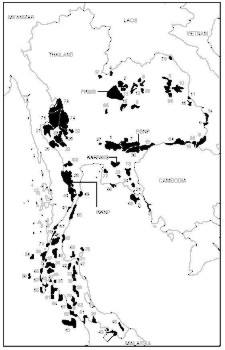
Study areas - KKNP, PSNP, KARNWS, and PKNP
Pang Sida National Park (PSNP) is located by The Khorat Hills in Srakaew Province, eastern Thailand
(Fig. 1). With 845 km2, the park is dominated by deciduous and
evergreen rain forest as well as lowland scrub and open grasslands at
the foothills, which reflects past logging activities. Surrounding
lands are deforested with agricultural use. The Houy Nam Yen Creek was
selected as the survey site due to many evidences of C. siamensis.
For example, a crocodile was sighted and photographed from a helicopter
there in 1992. And poachers claimed that they used to harvest
hatchling crocodiles from the creek as well. The creek located in the
western part of the park flows out of the western boundary of the park
into surrounding lowland country.
Khao Ang Rue Nai Wildlife Sanctuary (KARNWS) comprises of 108 km2 and encompasses hills covered in evergreen and
dry deciduous forests, with open grasslands in the lowlands. In most
of the sanctuary, there are several watersheds that eventually flow
into river systems well outside the sanctuary. Most creeks dry and
break up to form series of small pools in dry season. Klong Ta Kraw
Creek was surveyed once in 1993 by Ratanakorn et. al. (1994). The
creek is shallow and narrow and superficially seems to be sub-optimum
habitats for C. siamensis.
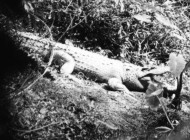
A 2.8-m wild Siamese crocodile in KARNWS
Phu Khieo Wildlife Sanctuary (PKWS) encompasses an area of 1,560 km2 in Chaiyaphum Province, northeastern
Thailand, approximately 550 km from Bangkok. The sanctuary comprises a
steep-sided plateau ranging from 540 m at its base to 1,310 m at the
highest peak. The plateau is drained by five watersheds: Lam Saphung,
Lam Nam Chi, Lam Dok, Huai Sang, and Huai Nam Phrom Creek. The latter
is the river reported to have a remnant crocodile population. Hill and
dry evergreen and dry deciduous forests with open grasslands in
lowlands are major types of forest.
RESULTS
Habitat and Crocodile Survey
Kaeng Krachan National Park (KKNP)
A series of survey carried out
in the Petchburi River, Kaeng Krachan National Park from dry season
2001 to wet season 2002. The 30 km stretch of river from the watershed
to a reservoir is a rapid flow system with couple deep pools. The
sighting of C. siamensis in this river has been reported. Two animals
were caught there some thirty years ago and put into a farm. However,
no reliably positive identification has ever made until recently. A
photograph of a 2-m crocodile was recovered from a camera trap. We are
able to confirm three locations where signs of crocodiles were
discovered.
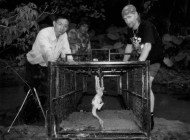
Live trap used in Kaeng Krachan National Park
First of all, the first
camera-trap photograph of a Siamese crocodile from Thailand was taken
in March 2001 by a field team from Royal Forest Department and WCS, in
the course of a tiger survey. We visited and surveyed the area in
early 2002 and found an old footprint at UTM coordinate 0531939
1425677. Next, the fresh sign of a crocodile is a drag mark and a
footprint of approximately 2m crocodile at UTM coordinate 0533145
1416876. The size of the footprint is similar to the one previously
reported by Platt et al. (in press). The location is approximately 13
km upstream from the site of the photo record. The footprint measures
175 x 125 mm. It was a right rear foot. It situated at the edge of the
sandbar where sand is tiny grain. The left rear footprint was not
shown distinctly because the substrate is the coarse grained sand.
Tail drag lies next to the footprint with 40-mm width. This indicates
that the animal is approximately 2m. The crocodile was observed a week
before by a helicopter pilot and a wildlife photographer. Several
efforts to try to capture a crocodile that was camera-trapped were
carried out, but due to the fact that there was no fresh track found
at the location. We got a water monitor in one of the live traps (Fig.
2). The species is extremely common in the area and its sign could
confuse an inexperienced observer. We also used a combination of
snare, rope trap and baited snare.
From the surveys, we were able
to verify the photo observation and to visit a fresh track spotted a
week before. We could not capture one and that may be because a recent
rain that obscure all tail drag and foot print. Observation and
sampling of potential prey item prove that this area can support a
population of C. siamensis. Protection is above average according to a
large number of carnivore species. And the last but not least, a
remnant population lives here. KKNP is, therefore, considered as a
re-introduction site.
Pang Sida National Park (PSNP)
The first set of surveys
provided an update information of a remnant population of C. siamensis
in PSNP. The surveys on the main section (16.7 km) of Houy Nam Yen
Creek was repeated several times. The whole section of the creek was
walked, paddled, and some time just drift away on bamboo raft. Several
basking sites were spotted, three of which could have been made by
moderate-sized crocodiles or monitor lizards. With the size of 2 m2,
these basking grounds are located between Wang Yao and Wang Mon (Start
and stop point of line transects). Unfortunately, 72-hour observation
failed to locate a positive sign of crocodiles. Two helicopter
surveys for nesting activities in dry season were not able to locate a
nest.
The surveys for hatchling
crocodiles in wet season were carried out during July - August 2002 in
the same area and beyond Wang Mon where never been surveyed before by
any research team. We located a hatchling drift across the creek at
UTM coordinate 0191145 1553582, but due to dense vegetation we were
not able to capture it. We also located a footprint measured at 125 x
105 mm. The footprint could belong to a 1.2-m crocodile. We estimated
that there is at least a breeding pair, a juvenile, and a pod of
hatchling crocodiles. Habitat and food availability is sufficient to
support a small population of crocodiles. Through out the entire
creek, there are several deep pools, plus the water is running all
year round. The depth of the bottom reaches 3.5 m while the range of
the width is 2.5-30 m. The slope of the bank is minimum with abundant
aquatic vegetation such as Cyperus sp.and Sagittaria sp.
Khao Ang Rue Nai Wildlife Sanctuary (KARNWS)
Several visits were paid to the
basking sites (the location is confidential) which belong to one
individual (Fig. 3) in Klong Ta Kraw Creek, KARNWS. We almost always
find the animal by one of the basking areas. From 120-hour observation
during both day and night, the animal usually surfaces quietly and
does not panic when he realizes the presence of humans. He, then,
submerges upon arrival and leaves only bubble trails on the surface.
Twenty minutes thereafter, he comes back up to breathe for 2 minutes
and submerges again for another 20 minutes. Water level appeared low
and seemed to be lower till the rain falls. In wet season vegetation
on the basking ground is dense, which suggests that the animal had not
used the site for a while or he basks only in the dry season. Line
transects reveal two more basking sites normally used by the
crocodile. A number of scatters collected from these sites proved that
the animal has sought a much more secluded site to bask and hide away
from us. Later analysis of the scatter uncovers the taxons, which
normally being preyed upon by a wild crocodile. The majority of preys
are freshwater fish such as Probarbus spp., Channa spp., and Clarias
spp. Small mammals' fur is accounted for only 5% w/w of the scatter. A
skull of Pig-tailed macaque was discovered by a sanctuary ranger near
the creek seemed surprised but not impossible that it was taken by C.
siamensis. Upper stream is broken in dry season with only two small
pools. Downstream the creek runs toward sanctuary border and end at the
Si-Yad Dam near park border.
Observation data show that the
crocodile lives mostly under water. He is highly secretive. He basks
only in the morning after a cold night. Amidst breeding season, the
minimum activity suggested that there is only one crocodile in the
area. The sex is therefore unknown because in captivity the size of
some females does exceed 2.5 m, while this individual is estimated to
attain 2.8 m. Habitat suitability for a small crocodile population looks
promising, provided that illegal hunting is under control. A few
pools in dry season can accommodate just less than 10 crocodiles.
Later relocation of crocodiles to other stretches in the sanctuary is
an alternative if there is a severe drought. Although intraspecific
competition can be high, interspecific competition is minimal due to
small number of salvators and other large reptiles.
Phu Khieo Wildlife Sanctuary (PKWS)
Kreetiyutanon and Khumsuk
(2002) photographed a footprint with a measurement 220 x 170 mm for a
fore foot track and 210 x 190 mm for a rear foot track. Three basking
sites were located near Huai Nam Phrom Creek as well. From the
measurement, the animal may have a total length of up to 3.5 m. Two
more footprints were reported in a different section of the creek.
Therefore, at least 3 crocodiles live separately in PKWS. The plan to
conduct more surveys in PKWS is set for this dry season. Currently,
the current is strong and unpredictable.
DNA Updated Results
We were able to distinguish C.
siamensis from C. porosus. We applied the American alligator
microsatellite markers to differentiate both species. It is now in the
process of cloning a specific microsatellite marker for the Thailand
Siamese crocodile. The DNA samples are from captive animals. We expect
to capture a wild crocodile in each study area to represent
geographical variation in genetic material, in order to check genetic
diversity and the range of heterozygosity of potential release stocks.
A few groups of captive-bred crocodiles were selected from CMAT
members' crocodile farms. Most were tested for purity of gene.
Interview surveys
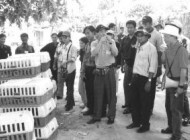
Interview surveys with park rangers, sanctuary, and local conservationists
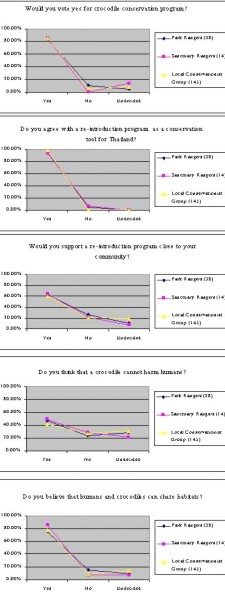
From interviews of 38 park
rangers from KKNP and PSNP, 14 sanctuary rangers from KARNWS and PKWS,
and 145 local conservationists near KKNP, PSNP, and KARNWS, the
results show a significant increase in the number of supporter. Figure
4 could be summarized that people tend to support the project if they
are well educated by a project coordinator. Although they are reluctant
to welcome crocodiles into their vicinity, half of them think that
crocodiles may bring no harm to humans. The need for community
outreach and education to create a suitable social climate for
accepting wild crocodiles is part of the project (Fig. 5). Social work
with education program for schoolchildren and community was
considered a major strategy. In KARNWS, local people form a group of
conservationists. They campaign against construction of pavement road
leading to the crocodile site, since they are afraid the poaching
pressure would be out of control.
CONSERVATION STATUS AND POSSIBILITY FOR RE-INTRODUCTION
Threats from poachers and
aloewood (Aquilaria spp.) collectors with fishing and hunting
activities have always been a major problem of wildlife conservation
in developing country. Further natural threats such as flooding and
interspecific competition are also major problems. Although most areas
have suitable habitat, threat to crocodile may hinder the success.
Together with the Royal Forest
Department, we plan to minimize threats to the species such as
poaching and fishing, and restore or adjust environment to make it
suitable for released animals. We emphasize on monitoring the core not
the edge habitat of release areas. We also plan to release the
genetic pool that is as similar as possible to the existing wild
population. The release of juveniles is in a cause of several years
within designated areas. In each area, crocodiles will be released
together to make certain that they will not disperse to the distance
that make social gathering, mating, and monitoring almost impossible.
Every precaution has been taken
to make this re-introduction program the best conservation tool for
Thailand Siamese crocodile. Everything that goes into this program has
been checked and rechecked to insure long-term survival. We,
therefore, sincerely hope that every step of the program will be
successful. It is evident that this is going to be a long term and
quite slow process, but we agree that the careful and cautious approach
is likely to address some of the deep institutional and cultural
issues around crocodile re-introduction in a successful way.
MANAGEMENT AND CONSERVATION RECOMMENDATIONS
1. Continue promoting
sustainable use of captive-bred crocodile products, which is part of
"wildlife trade campaign" by WWF-Thailand to stop illegal trade of
wild fauna and flora.
2. Royal Forest Department and
Thai government must enforce protection to minimize poaching and
fishing pressure. Today, National Park Division is budgeting the
tourist infrastructure to promote many pristine tourist spots in most
parks. This could bring an end to poaching behavior.
3. Expand an already established market-driven conservation program to the greater extent
4. Risk assessment must be
conducted to evaluate the risk involved within project and from local
communities, in order to increase public awareness.
5. A re-introduction workshop
needs to be set up with representatives from the Royal Forest
Department, Fisheries Department, Mahidol University, NGO, breeders,
producers, and leather industry to discuss the following issues: wild
population status, in-situ management, effort of market-driven
conservation for Thailand program, and local sustainable development.
ACKNOWLEDGMENTS
We wish to thank Dr. Plodprasop
Suratsawadi, DG Royal Forest Department, for the research permit to
conduct a study in protected areas. Dr. Napawan Nopparatnaraporn's
help with DNA analysis is greatly appreciated. Special thanks go to
Sriracha Farm Group for technical support and training for sanctuary
rangers. We further want to thank all park and sanctuary rangers who
assisted in series of surveys. FFI 100% Fund no. 02/21/06FLAG, YAP,
NGTV, and CMAT grant no. 4401 and 4501 were sources of funding for the
research. Finally, we would like to thank Dr. Robert Mather,
WWF-Thailand for pioneering "The Wildlife Certification Scheme" to
help prevent illegal trade of wildlife and promoting sustainable use
of captive-bred animals that leads to market-driven conservation.
LITERATURE CITED
Boonyakhajohn, S. 1999. Pangsida National Park.
PSP, Bangkok 72 p. Dijk, P. P. V. 1999. Some thoughts on reintroduction
of Siamese crocodiles to Thailand. CSG Newsletter, V. 18, No. 1:
p. 7-8. IUCN. 1971. 1971 IUCN Red List of threatened animals. IUCN,
Gland, Switzerland. IUCN. 1992. Draft guideline for re-introduction.
IUCN, Gland, Switzerland. Kreetiyutanon K., and M. Khumsuk. 2002.
The occurrence of the Siamese crocodiles in Phu Khieo Wildlife
Sanctuary. Croc News 10: 1; 15-18.
Platt, S.G., A.J. Lynam, Y.
Temsiripong, and M. Kampanakngarn. In press. Occurrence of the Siamese
crocodile (Crocodylus siamensis) in Kaeng Krachan National Park,
Thailand. Nat. Hist. Bull. Siam Soc.
Ratanakorn, P., B. Amget, and B. Otley. 1994. Preliminary Surveys of Crocodiles in Thailand. pp. 35-56. In:
Crocodiles. Proceedings of the
12th Working Meeting of the Crocodile Specialist Group, IUCN - The
World Conservation Union, Gland, Switzerland. Volume 1. Ross, J. P.
(ed.). 1998. Crocodiles. Status Survey and Conservation Action Plan.
2nd Edition. IUCN/SSC
Crocodile Specialist Group. IUCN,
Gland, Switzerland and Cambridge, UK. Viii + 96 pp. Smith, M. A. 1919.
Crocodilus siamensis. Journal of the Natural History of Siam. Vol. 3,
No. 3.
Temsiripong, Y. and P. Ratanakorn.
2001. A review for reintroduction program of Siamese crocodile in
Thailand. Proceedings of the Regional Working Meeting of the Crocodile
Specialist Group, Guangzhou, China, IUCN - The World Conservation
Union, Gland, Switzerland and Cambridge UK. Temsiripong, Y. 2001.
Re-introduction of the Siamese crocodile. CSG Newsletter; V.20, No.1:
p.10-13. |


