|
 |
|
 |
|
| Other / Services - Induced Pairing Of Captive Hornbills In Khao Kheow Open Zoo, Chonburi |
|
|
| |
|
|
 Urarikha Kongprom* Urarikha Kongprom*
|
Rattapan Pattanarangsan**
|
Chainarong Pankong* |
| Abstract |
The study of induced
pairing of solitary individual hornbills in captive conditions in Khao
Kheow Open Zoo, Chonburi from 2000 to 2004 by installing nest boxes
and controlling of feed availability met some success in some
hornbills species. The success of this study were; 2 pairs of Great
Hornbills (Buceros bicornis) from 8 individuals, 5 pairs of Oriental
Pied Hornbill (Anthracoceros albirostris) from 12 individuals, 1 pair
of Rhinoceros Hornbill (Buceros rhinoceros) from 6 individuals and 1
pair of White-crowned Hornbill (Berenicornis comatus) from 5
individuals.
Key words: induce pairing, captive hornbills, Khao Kheow Open Zoo
* Khao Kheow Open zoo, Bangpra, Sriracha, Chonburi, Thailnd 20110
**Faculty of Veterinary, Mahidol University, Salaya, Nakornprathom 73170
Introduction
KKOZ is one of the five zoos under
umbrella of “The Zoological Park Organization under the Royal
Patronage of His Majesty The King”, or ZPO. The ZPO is one organization
under the Ministry of Natural Resource and Environment, which has as
its principal mission the conveying of a conservation message to the
public, especially youth. Conservation in zoos aspects is in zoos’
objectives; to give recreation in a zoological park environment, to
transfer education through wildlife management, to help conserve
wildlife in situ and to produce research works which help in answering
conservation questions. Since the year 2000, Khao Kheow Open Zoo had a
number of individual hornbills which had never been bred, or even
attempted to pair. In the past, hornbills were often donated to the zoo
and zoo people did not give them much attention or attempt to breed
those hornbills. But the situation in the wild changed due to habitat
loses and poaching, and new birds are very difficult to obtain from
the wild. Zoos were the obvious place to breed those donated hornbills
to replace the collection.
Khao Kheow Open Zoo had accomplished
breeding hornbills which already paired in its previous research;
Comparative Study of Captive Sympatric Paired Hornbill, in Relation to
Nest box Materials, Dimension, Shapes and Installing Sites in 2000.
One conclusion that was made from that study was that a strong
pair-bond is one crucial factor to the success of breeding. While in
situ conditions had produced a number of behavioral researches to
start with, the zoos had planed to do induced paring in captive
hornbills.
In natural behavior, the male will
find a good nest hollow and defend it from other males or other
animals. At the same time, that male will try to attract the female
with “high-priced” feed such as lizards, snakes, birds or other
protein-rich feed. The female is the chooser, or the one who finishes
the paring process. The female will accept feed, sometimes just
throwing away some of those “high-priced” feed to test the male’s
ability to find food. Then, if the female is satisfied with the treat,
she will follow him to the nest hollow site. The male will use the
food to lure her to the exact place of the nest hollow, sometimes even
throwing feed into the hollow, if the female is new to the paring
process. She will, then, examine the hollow for aspects such as space,
height and strength. If she is satisfied with the hollow, she will
accept mating and the breeding process begins. In some cases, the male
will also provide sealing material to attract the female too.
In the zoo, the research was designed
principally to use the availability of nest boxes and availability of
feed as tools to induce paring. Nest box installation method will be
defined in detail into either side or both individuals to see if it
will affect the attempt to start of the male, or acceptance of female,
and how much effect will be measured. The feed availability aspect
was performed through measuring the amount of feed-intake of both
sides and then gradually reducing the amount on the female side, while
increasing that on the male side. The assumption is if the male has
“too much”, he will start to give away the pairing purpose, while the
female will accept the male more easily for the feed’s sake.
We will gain information in terms of
the degree of male attempts to feed and the female’s acceptance. In
the end, the combined techniques will be used to see the ultimate
result, “the successful paring”.
Objective
1. To increase breeding pairs
2. To guage the effectiveness of the nest box installation technique
3. To guage the effectiveness of the feed availability technique
4. To guage the effectiveness of the combined technique of the two methods Materials
• 6 individual Great hornbills (Buceros bicornis)
• 6 individual Rhinoceros Hornbill (Buceros rhinoceros)
• 5 individual White-crowned Hornbill (Berenicornis comatus)
• 12 individual Oriental Pied Hornbill (Anthracoceros albirostris)
• Individual paring cages for large hornbills: 13 cages
• Individual paring cages for small hornbills: 12 cages
• Nest boxes for large hornbills: 2 boxes
• Nest boxes for small hornbills: 2 boxes
Methods
| 1. |
Nest box Installation technique |
|
1.1. |
Install a nest box in male cage |
|
|
1.1.1. |
observe male response to nest box, indicate if male is satisfied with the box |
|
|
1.1.2. |
measure amount of attempt to feed female in unit of time |
|
|
1.1.3. |
measure amount of acceptance of female in unit of time |
| |
1.2. |
Install a nest box in female cage, |
| |
|
1.2.1. |
observe female response to nest box, indicate if female is satisfied with the box |
| |
|
1.2.2. |
measure amount of attempt to feed female in unit of time |
| |
|
1.2.3. |
measure amount of acceptance of female in unit of time |
| 2. |
Feed availability technique |
| |
2.1. |
measure amount of feed in each individual as “status quo” |
| |
2.2. |
reduce feed in female
side while increasing feed in male side up to 80 and 120 % to “status
quo” and measure of attempt to feed female, and female acceptance per
male attempt |
| |
2.3. |
provide “high-priced”
feed to male such as mouse, gecko, etc. measure attempt to feed female
per feed provided, measure female acceptance per male trial |
| 3. |
Combine two techniques |
| |
3.1. |
measure total female acceptance in combined induced condition |
| |
|
|
|
|
Results in some success cases Neighboring cage organizing
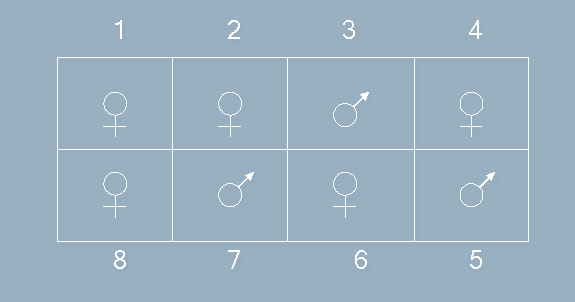
In Great hornbills and Rhinoceros Hornbills,
they were organized in the following diagram. From this organized
system, each individual would have the opportunity to meet with
opposite gender as much as possible. Female in cage 1 could have
access to 1 male, female in cage 2 had access to 2 males, female in
cage 4 had access to 2 male, female in cage 6 had access to 3 male and
female in cage 8 had access to 1 male. After a period of observation,
the female with the most potential was moved to cage number 6 to have
more male to be chosen. The females with the least potential were
moved to cage number 1 and 8. The male with the least potential was
moved to cage 5. |
| |
 |
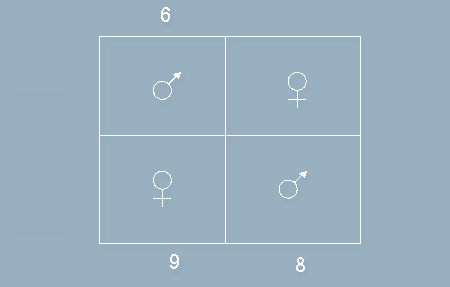
| In Oriental Pied hornbills, the cage was organized in this manner, to allow the most access to opposite sex. |
 |
| Appendix I ; some behavior of success pairing from year 2000 to 2004 |
Species |
Some interesting behavior |
Male Greater Hornbills cage No 7
November, 2000
|
Very exited
to have a nest box in the cage. Exploring took place on the first day.
Female watching male exploring. A week after nest-box installation, a
gecko was given to the male, he brought that gecko to eat near female
cage but did not give it to her. For a month, the male tried to feed
all 3 females, female in cage 2 accept and receive the most frequent
feeding. After observing for 1 month, Male 7 and female 2 were moved
to the breeding cage. |
Male Rhinoceros Hornbills cage No 7
December, 2001
|
We tried
neighboring cage organizing, nest box installation the same way as
Great Hornbills. Male 7 chose Female 6. They were moved to breeding
cage. |
Male Bushy Crested Hornbills
October, 2003
|
The male
explore the nest-box since the first day. He brought feed to feed near
female cage but not feed her. Female observed male nest-box
exploration. No feed giving or staying close behavior were observed. |
Female Bushy Crested Hornbills. October, 2003 |
Female
brought feed to eat near Male cage. When her feed was finished, she
pecked the male cage. On some occasions, she pecked the male beak
vigorously. Female 7 did not perform this behavior. |
Female Bushy Crested Hornbills May, 2004 |
Installed a
nest-box in female cage. Female explored the nest-box immediately by
pecking the opening, sticking her head to observe inside. Nest-box
exploring was daily behavior. After a period of nest-box exploring,
she took feed to show to the male. Female 7 and Male 8 exchanged feed
more frequently, without pecking too vigorously. Both birds were moved
to breeding cage. |
Oriental Pied Hornbill October, 2000 |
Male was
last-year breeder, but the female died. Brought the male to breeding
cage, put female in holding area. After 2 weeks, male brought soil and
put in female cage every day. Open door and female flew to male cage.
This technique was already used and successful for 2 pairs. |
Oriental Pie Hornbill October, 2001 |
In a paring
process, male brought feed to give to female. Female straightened her
neck for the male to preen. On some occasions, male straightened his
neck for the female to preen too. This behavior occurred in 2
successful pairs. |
|
Result and Discussion
Combining three techniques; nest-box
installation, female feed reduction and provide “high priced” (such as
mouse, lizard, gecko) feed to male can induce courtship behavior.
Combining three techniques gave a better result than using each
technique solely. Nest-box installation gave better stimulation than
female feed reduction technique.
Using these techniques, we can pair 2
pairs from 8 Great Hornbills. (in 2 years; 1 in 200 and another 1 in
2001). We got 1 pair of Rhinoceros Hornbills from 6 individuals in
2001. In Bushy Crested Hornbills, we got 1 pair from 5 individuals in
2003-2004. This pairing took a long time due to the fact that the male
had not reached puberty and was younger than female 4-5 year. In
Oriental Pied Hornbills, we got 3 pairs in 2000, 2 pairs in 2001. We
produced more than 20 chicks in the breeding program, this led to the
next plan to release captive-born birds into the wild in 2004 to see
if the captive-born can survive and reproduce in nature.
In case that female was ready but male was
not ready, there were some behavior recorded such as: the female
showing aggressive behavior by strongly pecking the male with her
beak.
Because the main aim is to breed these
valuable hornbills, we cannot design methodology which inlcudes every
fine detail. The more important purpose is to breed than to know
effects of each treatment, so we were trying in any way to accomplish
that. However, from our observations and daily records, we can make
some assumptions, which will be shown in appendix I.
|
|
|
| |
|
|
 |
|
 |
|


