|
 |
|
 |
|
| Other / Services - Hornbill Project |
|
|
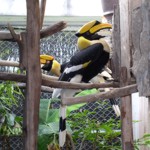
Hornbills are large distinctive tropical birds, found only in the African and Asian continents. These are the only birds that have a two-lobed kidney and the only
ones in which the first two vertebrae (the axis and atlas) are fused
together. There are 54 species of hornbills in the world out of which
13 of them have been recorded from Thailand alone. Hornbills play some
important ecological roles such as dispersal of seeds from the fruits
they eat and control of some prey species. Some scientists are also
using Hornbills as an ecological indicator to indicate good condition
of the forest as the forest bares enough food and contains big trees;
trees that Hornbills use for breeding must be very large with large
diameter so that females and chicks can stay inside the cavity with
ease.
Habitat: Rainforests are the major habitats for Asian hornbills. Some species
are found in deciduous forest such as great hornbills and oriental pie
hornbills.
Feed: Hornbills are primarily fruit eating birds. They eat various species of fig (Ficus sp.) More than 60 species of non-fig fruits are consumed by them. However,
some of them like Brown hornbills even eat some small animals such as
mouse, lizards, snakes, geckos and some insects for protein and
calcium source.
Breeding: Hornbill's breeding season starts late rainy season from October to
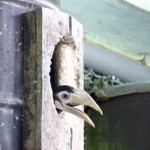
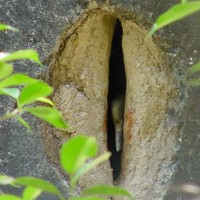
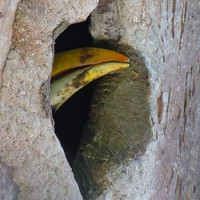
May. Hornbills use the cavity in the tree for building their nests. The
nest sizes are measured up to their body size. The Breeding behavior
of the Hornbills is very attractive for wilderness enthusiast for
these birds pair for years and sometimes, for their entire life. When
the male meets an attractive female, he tries to spoil her with
valuable feed such as; prey animals or juicy fruits. Females then test
her mate-to-be by trashing those gifts away. The Male will try again
and again to show his ability and will also prepare appropriate
surrounding conditions for the females to lay eggs. When female accepts
that male, he will further lure her to the nesting site by precious
feed. She then, observes the nest cavity and if she is satisfied, she
will allow that male to copulate several times in a day. While she is
going in and out and starts to seal the opening with mud, food and
faeces, the male keeps bringing her the precious feed and copulates
too. Female will lay several eggs and incubate them till the hatching
day. Large species sometime burst the seal to help the males feed
their chick's. Females of smaller species will stay inside the nest hole
and go out the same time when the chicks fledge.
Status: The
major limiting factors for the decline in the number of hornbills are
the decrease in the number of their and not enough nest cavities. Many
of the rainforests are being used as human settlements and agricultural
areas; the minor reasons being hunting and poaching. Now, IUCN status
of this species is critically endangered. CITES categorized these
species into appendix 1. |
 |
 |
 |
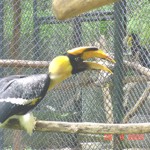
Captive breeding: This is the first recorded breeding success of Khao Kheow Open
Zoo(KKOZ), Chonburi Province, THAILAND. KKOZ is one of the five zoos
under the umbrella of "The Zoological Park Organization under the
royal patronage of His Majesty The King". The organization is under
supervision of The Department of Natural Parks, Wildlife and Plants,
The Ministry of Natural Resources and Environment. |
 |
 |
The main
idea of this study is to intervene with the limiting factor and make
them offering factors. The major target is to obtain more successful
breeding while learning. "How" and "Why" the birds choose their nest
hole. The results of this study can be used as a recommendation for nest
box construction which can lead to more promising outcomes.
Scientists who work on "Artificial nest box programme" for wild
hornbills can also use information gained from this study to design
artificial nest boxes.
The authors wish to contribute this
information to enhance captive breeding which will assist conservation
of these critically endangered species both in wild and captive
conditions.
Objectives
1. The nest box selection plays an
important role in Hornbill's captive breeding which will reflect the
success of the captive breeding programs. We therefore need to know
"how" the process of nest box selection done and "why" do hornbills
select those particular nest boxes only.
|
 |
 |
2. The
controlled factors of research were run under proven conditions of
successful breeding, both in the natural and captive condition. The
conditions were; nutrients requirement, thickness and dimension of
holes' opening, minimum space requirement, nest hole-filling
substances, height of the floor to hole opening .The hornbills in this
project already showed paired behavior.
3. Variance factors for
the nest boxes are space or dimension, shape, materials and height
installing sites. These factors and the interactive behavior can
determine reasons for selection; preferences of more space, firmness
of nest boxes, fluctuation of temperature, security, imprinted shapes
of previous use as chicks and preference of low temperature. 4. Aim is
to use the results from this study to enhance recommendations of nest
box production and installing to the management.
5. The results of this
study can also help artificial nest box programs for the wild
hornbills in the required area, as some areas are already facing the
limitation of nest boxes and affected number of success breeding
pairs.
Results
General
1. From two seasons of the study (2000 -
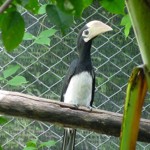
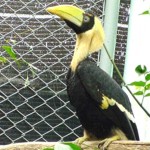
2001), we obtained 10 chicks; comprising of 9 Oriental Pied Hornbills
and 1 Greater Hornbill. |
 |
 |
2. The success birth rate
is 50% i.e., 7 out of 14 pairing attempts. The 7 successful cases
comprised of 2 pairs from the first year and 5 pairs from the second
year. The 2 pairs, which were successes from the first year, still
proved to be successful in the second year.
Installing sites
1. In conclusion, the success of birth
rates was found in pairs that selected nest boxes that were installed
at the higher sites. |
|
3.Notice from the study:
The species that used box-shaped boxes were the Greater Hornbills and
Wreath Hornbills, which are considered as large species. Dimension may
contribute to this action.
Sex and the observation
1. From 16 boxes observed, 50 % was observed from both sexes and 50 % was solely from female.
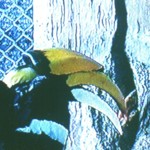
2. All 8 boxes that were observed from
both sexes, males were in advance to observe in every case. But most
of the observations from males were protruding of the head into nest
opening while females were going into the boxes. |
 |
3. In
conclusion, all the successful boxes, females are the nest box
selector. Nevertheless males remained observers .But whenever males
protruded heads into the boxes, females would also follow with his
observation.
Materials
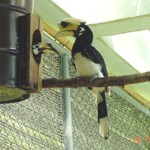
1. From 7 successful cases at chick
obtaining rate; Pile wood box was used 1 box (as 14.29%), concrete
pipes were used 3 times (as 42.87%), metal barrels were used 3 times
(as 42.87%) and wooden stripes boxes were not used at all. |
 |
2. From 16
successful cases at going-in rate; Pile wood boxes were observed 25.00
%, concrete pipes were observed 18.75%, metal barrels were observed
18.75% and wooden stripe boxes were 37.50%.
3. From 206 successful
at observed rate, Pile wood boxes were observed 70.39 %, concrete
pipes were observed 1.46%, metal barrels were observed 9.22% and
wooden stripe boxes were 18.39%.
Pile wood boxes
were the most attractive to observe, but the most successful nest
boxes were concrete pipes and metal barrels.
Temperature
1. Different temperatures
(lower) from ambient are different in each material. The most
different were wooden boxes. Pile wood boxes, concrete pipes and metal
barrels were lower in difference, consecutively.
2. Fluctuation of
temperature in day-time was least in wooden stripe boxes. Pile wood
boxes, concrete pipes and metal barrels were lower consecutively.
Conclusion and discussion
Controlled Factors
Relationship between hornbills: Every pair of hornbills was observed to be paired already at the
least rate of staying close together. This factor was found to be
crucial for this study. Some pairs that showed no sign of paring
behavior was excluded from the study. The paring behavior is studied
in other research categories, undertake by the same authors.
Hornbill body condition: We were able to measure the health of the hornbills through
physically examining each individual to determine the weight and muscle
consistency around the keel. This was done by using the Body Condition
Index (David, 1945) in which we palpate the breast muscles and
sternum (keel). The degree of development or energy storage of
skeletal muscles can be estimated. The body condition index is graded
on a scale of one to five, with one being very thin and five being
well-muscled or plump. All the hornbills measured were found to be not
less than two on this scale.
Age: We
were able to estimate the age of the hornbills by the size of the
casque and the color of the iris. All birds in this study were adult.
Diet: Oriental Pied Hornbill: Food is offered once daily, comprised of banana cubes, papaya cubes
and grapes, with commercial dry dog feed. For Great Hornbill; food is
offered once daily, a similar diet to that of the Oriental Pied
Hornbill but offered with the addition of milled rice with boiled eggs
( mainly for sealing purpose ). These additional items are rolled into
1-2 cm. diameter balls. Supplements to the diet include seashells
finely ground for calcium supplement which is sprinkled on the food
every day. Two types of the following items were added daily as
compliment; guava cubes, orange pieces, boiled pumpkin cubes, boiled
carrot cubes, fichus fruits, black plum fruits, pinky mice, and pieces
of pork meat, small lizards and geckos. The amount of individual
items remaining in the food tray must be weighed every day. If one
type of food is completely consumed, we increased that item to try and
determine which food item was preferred. At an average number, feed
composition (from feed intake study) comprise of proteins at 12.18%,
fat 3.73%, calcium 0.71% and phosphorus 0.49%.
Cage: Size of enclosure used in study is 4m wide by 8m long by 3m tall.
Nest Site: We used a
total of 8 nest boxes with 4 set approximately 2 meters high and 4 set
30cm off the ground. Boxes were made from pile wood, metal barrels,
concrete pipe, or wooden stripe assembling together in cylindrical
shape and seal with cement.
Height of nest opening: Access to the nest boxes was 7-10cm from the bottom of the box.
Opening dimension: Larger hornbills such as; Great Hornbills and Rhinoceros Hornbill
entry size was approximately 15cm. in width and not less than 20cm in
height. Smaller Hornbills such as the Oriental Pied Hornbills, entry
size was 10cm wide and not less than 16cm high. Elliptical or oval
shape openings can be used but irregular shape with high streak
opening is more suitable as the hornbills can seal this shape more
effectively. |
|
Nesting debris: Materials added to all nest boxes includes; soil, wood shavings,
decayed wood from local forest. This material is added to a depth of 5cm
high inside nest box. Some birds would then remove materials on their
own from within the boxes. Materials utilized by hornbills to seal
the cavity include a mixture of nesting material, food and fecal
material. In 2001, a plywood nest box was chosen by the Great
Hornbill; however the seal was not maintained properly due to the
hornbill's addition of bananas to the mixture. This food choice did not
dry adequately and acted not suitable as a sealing material. In 2002,
the same pair of birds used milled rice with boiled egg yolk resulting
in a successful seal.
Variable factors
Installing sites: The higher found to be better.
Shape and dimension: In small hornbills, pile wood boxes that had more space to the other
shapes were observed more frequently but the hornbills chose concrete
pipes and metal barrels without choosing any pile wood boxes. Contra to
large hornbill species, wooden stripe boxes were more frequently
observed but not accepted. The successful pair chose pile wood boxes
which was the most space offering. Construction of wooden stripe may
have flaws, as we cannot seal the wooden stripe to the point that no
small hole presented.
Temperature: The best
materials to keep temperature most lowly to ambient and least
fluctuate were wooden stripe boxes. The wooden boxes were observed the
most but none were selected at chick obtaining rate. This was against
hypothesis that suggests temperature keeping is one of the most
preferable factors as in the wild. In the wild, the birds prefer live
tree than dead tree.
Materials: Concrete
pipes and metal barrels were most used in successful cases; pile wood
box was following in the success rate. While Concrete pipes and metal
barrels were prominent in durability and security, but gave no good
condition for temperature keeping, lower in space and dimension. We
think that in captive condition that gave fair change of temperature,
security is more preferable than space.
Suggestions for Nest box Management
1. For small species, metal barrels or
concrete pipes were the most recommended. Installation must be as high
as possible. Metal barrel has advantage of light-weight and easy to
install.
2. For large species, pile wood boxes
were most recommended. Install at high site, give more space and
modify opening as close to nature as possible. |
|
|
|
| |
|
|
 |
|
 |
|